Showing posts with label Learning through play / Aprenent mitjançant el joc. Show all posts

Nov 2, 2014

Joguines de la natura / Nature Toys


Aquest estiu vam descobrir aquest meravellós llibre escrit per Christine Armengaud. Ens ha inspirat moltes aventures i jocs a i amb la natura. Ací teniu algunes imatges.  

This summer, we discovered this wonderful book by Christine Armengaud and it has inspired many playful adventures in and with nature. Here I'm sharing some pictures.


Un arbre de nadal
A Christmas tree

Mores!
Blackberries!


Nina feta amb una rosella
Doll made with a poppy


Textures

Un escenari, una plaça de bous, un amagatall, etc.
A stage, a bullring, a hiding place, etc.


Respect that which belongs to everybody. Thanks in the name of Nature.

Thanks for your comments 
Gràcies pels vostres comentaris

Jul 25, 2014

Playing with Gift 1 / Jugant amb el do número 1

A new-found Froebel friend (hi Tiffeni) told me she'd like to know how we're doing. Well, we've been playing with Froebel's Gift number 1 lately. And this is what we came up with.

Hem fet una nova amiga Froebel (hola Tiffeni) a qui li agradaria saber com ens va amb les nostres exploracions amb els dons. Bé, doncs hem estat jugant amb el do número 1. I açò és el que se'ns ha ocorregut. 
The provocation

Martí's busy hands
Les manetes de Martí es posen en marxa

Exploring movement


Aitana prefers pretend play
Aitana prfereix el joc simbòlic

Let's throw a birthday party!
Fem una festa d'aniversari!


Books about colours


Wearing the balls


We enjoyed making our home-made play dough. The cake had vanilla scent. We ran out of flour and Aitana wanted to have pink play dough, so I asked her what colours we should mix in order to get pink, and we both worked through an answer.

Ens va agradar molt fer la nostra plastilina. El pastís tenia aroma de vainilla. Ens vam quedar sense farina i Aitana volia plastilina rosa, així que li vaig preguntar quins colors podiem barrejar per tal d'aconseguir el color rosa, i entre les dos vam trobar una resposta.

Thanks for your comments 
Gràcies pels vostres comentaris

Jul 10, 2014

Where Froebel?

(La versió en valencià la trobareu més avall)

Aren't you fascinated by Froebel yet? I guess that, like me, you must be asking yourself many questions.
There is not much information available if you are looking for a step-by-step guide to apply a given curriculum. Froebelian pedagogy is an approach, not a method. 
Image from Norman Brosterman's Kindergarten Collection

While his 19th century writings or the writings about him by his contemporaries are available online (good news), the current demand isn't large enough to support publishing new literature on him and his educational system. (And it is so unfair! Everybody knows what a kindergarten is, but very little know about the man who created the first one).
Froebel's Third, Fourth, Fifth and Sixth Gifts
What I am doing is reading his own writings and some other interesting works written by other authors in order to get a more in-depth view of his way of seeing children and childhood. Actually, most of the innovations he pioneered in his time, are pretty much in tune with what progressive approaches defend nowadays. 
Here you have the list of the main works you may read (as recommended by Tiffeni Goesel). You can find all these books at the following links: The Froebel Archive from the University of Roehampton and Internet Archive.


The Education of Man  [Die Menschenerziehung] by Friedrich Froebel
The Pedagogics of the Kindergarten by Friedrich Froebel
The Paradise of Childhood  by Edward Wiebe
The Kindergarten Guide: vol. 1 The Gifts by Maria Kraus-Boelte & John Kraus
The Kindergarten Building Gifts  by Elizabeth Harrison
The Republic of Childhood vol 1: Froebel's Gifts and The Republic of Childhood vol 2: Froebel's Occupations by Kate Douglas Wiggin & Nora A. Smith
Daily Program of Gift & Occupation Work by Carolyn S. Bailey, Clara M. Lewis
The Psychology of Froebel's Play-Gifts  by Denton J. Snider
Symbolic Education  by Susan Blow
Third & Last Volume of Friedrich Froebel's Pedagogics of the Kindergarten  by Josephine Jarvis
Image from Norman Brosterman's Kindergarten Collection
In order to know about Froebel in the 21st century and how other people work the Froebel way, I like to read:
Tiffeni Goesel's Facebook page
Deb Chitwood's series of posts on Spielgaben educational toys.
Spielgaben's learning resources page.

You can also have a look at my pinterest board.


Encara no esteu fascinats per Froebel? Supose que, com jo, també heu d'estar fent-vos moltes preguntes. 
No hi ha molta informació disponible, si el que esteu buscant és una guia pas a pas per aplicar un curriculum determinat. La pedagogia Froebeliana és un enfocament, no un métode. 

Encara que els seus escrits del segle XIX o els escrits sobre ell fets pels seus contemporanis estan disponibles en línia (bones notícies), la demanda actual no és prou gran com per donar suport a la publicació de nova literatura sobre ell i el seu sistema educatiu. (I és tan injust! Tothom sap el que és un jardí d'infants, però molt pocs coneixen l'home que va crear-ne el primer). 

El que jo estic fent és llegir els seus propis escrits i algunes obres interessants escrites per altres autors per tal d'obtindre una visió més profunda de la seva manera de veure la infància. En realitat, la majoria de les innovacions de les quals va ser pioner en el seu temps, estàn més o menys en sintonia amb el que els enfocaments progressistes defensen avui dia. 
Ací teniu la llista dels principals llibres que podeu llegir (recomanació de Tiffeni Goesel). Podeu trobar tots aquests llibres en els següents enllaços: The Froebel Archive de la Universitat de Roehampton i Internet Archive.


The Education of Man  [Die Menschenerziehung] per Friedrich Froebel
The Pedagogics of the Kindergarten per Friedrich Froebel
The Paradise of Childhood  per Edward Wiebe
The Kindergarten Guide: vol. 1 The Gifts per Maria Kraus-Boelte & John Kraus
The Kindergarten Building Gifts  per Elizabeth Harrison
The Republic of Childhood vol 1: Froebel's Gifts and The Republic of Childhood vol 2: Froebel's Occupations per Kate Douglas Wiggin & Nora A. Smith
Daily Program of Gift & Occupation Work per Carolyn S. Bailey, Clara M. Lewis
The Psychology of Froebel's Play-Gifts  per Denton J. Snider
Symbolic Education  per Susan Blow

Third & Last Volume of Friedrich Froebel's Pedagogics of the Kindergarten  per Josephine Jarvis

Per saber sobre Froebel al segle XXI i com altres persones treballen a l'estil Froebel, m'agrada llegir: 
La pàgina Facebook de Tiffeni Goesel  
La sèrie de posts escrits per Deb Chitwood sobre les joguines educatives Spielgaben. 
Pàgina de recursos per a l'aprenentatge de Spielgaben. 

També podeu fer una ullada al meu tauler Pinterest


Thanks for your comments 
Gràcies pels vostres comentaris

Jul 7, 2014

Fascinated by Froebel / Fascinada per Froebel

Friedrich FroebelCredit: Hulton Archive/Getty Images

(La versió en valencià la trobareu més avall)

I'm planning to start a series of blog posts on Friedich Froebel. And for those of you who are not familiar with him, here is the first post: Why Froebel?

- Because he was a German pedagogue born 232 years ago and known as the father of kindergarten. 
- Because he honoured and deeply respected children.
- Because he saw mothers as the best teachers his kindergartens could have.
- Because he also valued the role of fathers as fundamental.
- Because he believed in the importance of play and guided self-activity of the child.
- Because he educated children to be creators.
- Because his vision was wholistic.
- Because his model was Nature.
- Because he was inspired by Pestalozzi, Rousseau and the German Romantic philosophers
- Because he inspired and informed the work of Maria Montessori, Rudolf Steiner or the Reggio Emilia approach.
- Because he influenced Modern Art (Paul Klee, Kandinsky, Piet Mondrian) and Design (architects such as Frank Lloyd Wright).
- Because his educational view is still alive and far way valid (150 years before science could confirm it, he talked about such things as multiple intelligences).
- Because, if we want to prepare our children for the future world, we need to go back to such basics in order to harness their impulse for play as a biological imperative.

Froebel developed a system of gifts (wooden block play) and occupations (construction and workshop experiences and crafts) to be used at his kindergartens. However, they were not meant to be followed as a curriculum. In fact, they were part of a more holistic approach which included such other aspects as the use of garden, finger play, songs, nature exploration, etc.

All in all, the gifts hold an important place in Froebel's approach. 
Stay tuned for the next post... 


Tinc pensat començar una sèrie d'entrades sobre Friedrich Froebel. I per a aquells de vosaltres que no esteu familiaritzats amb ell, ací teniu el primer post: Per què Froebel? 

- Perquè era un pedagog alemany nascut fa 232 anys i conegut com el creador de les guarderies. 
- Perquè honrava i respectava profundament els xiquets/es. 
- Perquè considerava les mares com les millors mestres que les seues guarderies podrien tenir. 
- Perquè també valora el paper dels pares com a fonamental. 
- Perquè creia en la importància del joc i l'auto-activitat guiada dels xiquets i xiquetes. 
- Perquè va educar als xiquets/es per a ser creadors. 
- Perquè la seva visió era holística. 
- Perquè el seu model era la Natura. 
- Perquè va ser inspirat per Pestalozzi, Rousseau i els filòsofs romàntics alemanys. 
- Perquè va inspirar l'obra de Maria Montessori, Rudolf Steiner o l'enfocament Reggio Emilia. 
- Perquè va influenciar l'Art Modern (Paul Klee, Kandinsky, Pete Mondrian) i el disseny (arquitectes com Frank Lloyd Wright). 
- Perquè el seu punt de vista educatiu és encara molt viu i molt vàlid (150 anys abans que la ciència puguera confirmar-ho, va parlar de coses com ara les intel · ligències múltiples). 
- Perquè, si volem preparar els nostres fills/es per al món del futur, hem de tornar a aquests conceptes bàsics per tal d'aprofitar la seua necessitat de jugar com un imperatiu biològic. 
Mirror play with gifts 7 and 8

Froebel va desenvolupar un sistema de dons (el joc amb blocs de fusta) i ocupacions (experiències i activitats de creació i manualitats) per ser utilitzats en els seus jardins d'infants. No obstant això, no estaven destinats a ser seguits com un pla d'estudis o curriculum. De fet, són part d'un enfocament més integral que inclou altres aspectes com ara l'ús del jardí, jocs amb els dits, cançons, exploració de la natura, etc. Amb tot, els regals ocupen un lloc molt important en l'enfocament de Froebel. 

No us perdeu el proper post ...

Thanks for your comments 
Gràcies pels vostres comentaris

May 30, 2014

The Missing Alphabet, a review / una ressenya

(Baixeu per a la versió en valencià)

I've been reading on the topic of creativity lately. Before, I thought that it was something you were born with, something only talented or gifted people could have. And I also thought it only applied to artistic skills.
After reading The Missing Alphabet. A Parents' Guide to Developing Creative Thinking in Kids, I was glad to know that it can be taught / learnt by doing.There is a series of simple steps which make up the creative process and which are clearly explained in this extensively praised book, along with a great deal of proposals to help develop our child's (or our own) creative thinking.


But there is more to that. There is the question of the missing alphabet itself, the Sensory Alphabet. It should be as important (or even more) as learning the letters and the numbers, but it is often neglected at school. It is made up of a number of elements, from colour, to texture, line, or movement. Every child is more inclined to one or some of these elements. So the book helps us discover, understand and enhance these preferences, these individual strengths and creative potentials of our kids. How? By using a variety of media. And this is soooooo Reggio, that I couldn't resist it.
Using different media, with no apparent pattern, though.

I must confess that I have had to read some of the chapters in this book twice. Not because the contents were not clear, but because they were so new for me, that I needed to sink them in properly. After reading it, I started to look at Aitana and Martí's drawing, actions, preferences, with a different look, trying to find out what elements they resonate more with.
Creative thinking means thinking outside the box
And I came to a conclusion. It is not so important to know exactly what elements of the alphabet our children are more prone to, but to provide them with plenty of opportunities to use a variety of media every and anywhere (to integrate this sensory alphabet in our daily lives). 
Still, I was curious, so I wrote to one of the writers:

Hi Susie, 
I've really enjoyed your book "The Missing Alphabet". I've been reading and re-reading it and trying to find out what my daughter's creative strengths are (she's 4 and a half years old). My problem is that I know the answer to the questions you pose, but I don't always know how to relate such answers to a given component of the alphabet. For example: She likes imitating the images she watches on TV from her favourite film characters. She played the part of Snow White singing the song "Whistle while you work" and she made exactly the same movements and gestures as the film character. She also speaks and acts like her teacher when she's role playin (something she loves). She's also quite bossy/leader/alpha dog. I would say this means she's into rhythm, but I'm not sure if I'm right. She likes saying things with the tunes of a given song, changing the lyrics of songs in order to tell something. Does it have to do with rhythm or sound? Whenever she draws something, she uses many different media; colour pencils, rubber stamps, stickers, a plastic flower, pom poms, etc. Does it mean she's into texture? What she's definitely not into is light (in spite of this) and line (she doesn't like telling stories. She prefers listening, but she keeps on adding new characters, changing events, etc). She doesn't like building blocks or puzzles, either. I'm sorry to write such a long comment. Maybe you need more information in order to give me an answer, but I would appreciate any of your contributions. Thanks very much in advance.

And Susie was kind enough to answer my message and she told me that:
Her costumes always find some room in our luggage 

the use of different materials in art are rather rhythm oriented, as well as texture, especially if she uses pattern and repetition. She seems to have strong leanings towards rhythm, especially interpersonal and people-oriented. Rhythm kids love to try on different characters and that sounds like her approach to stories, too. It might be fun to give her a costume box (just put together with thrift store accessories and old clothes) and see if the texture and rhythm come together with characters in costume.
Sound and movement are probably also strong suits!

I couldn't agree more...


And as for Martí, he is definitely into rhythm, sound and movement.

A sneak peek of our playroom / atelier
He loves his musical tree, he is mad about music and following the rhythm with his head and body, he enjoys singing himself as well as being sung to sleep. He's a natural explorer, climber, runner.

I've been trying to provide Aitana and Martí with the most appropriate tools in order to fit their creative orientations. I've put into practice what I learned at my Playful Learning Spaces course. And I have decorated and equipped their playroom/atelier accordingly. I hope I can write soon about this space and show it to you.


He estat llegint sobre el tema de la creativitat últimament. Abans pensava que era una cosa amb què naixes, una cosa que només les persones amb talent o superdotats poden tenir. I també pensava que només s'aplica a les habilitats artístiques.
Després de llegir The Missing Alphabet. A Parents' Guide to Developing Creative Thinking in Kids, em vaig alegrar de saber que pot ser ensenyat / après amb la pràctica. Hi ha una sèrie de passos simples que conformen el procés creatiu i que estan clarament explicats en aquest llibre, juntament amb una gran quantitat de propostes per ajudar a desenvolupar el pensament creatiu del nostres fills/es (o el nostre propi).
Però hi ha més. Està la qüestió del propi alfabet perdut, l'Alfabet Sensorial. Es compon d'un nombre d'elements, com ara color, textura, línia, o moviment. Cada xiquet/a s'inclina més a un o alguns d'aquests elements. Així que el llibre ens ajuda a descobrir, entendre i millorar aquestes preferències, aquestes fortaleses individuals i potencials creatius dels nostres fills. Com? Mitjançant l'ús d'una varietat de mitjans de comunicació. I això és tan Reggio, que no vaig poder resistir-me.

He de confessar que he hagut de llegir alguns dels capítols d'aquest llibre dues vegades. No perquè el contingut no era clar, sinò perquè era tan nou per a mi, que necessitava assimilar-ho adequadament. Després de llegir-lo, em vaig posar a mirar els dibuixos, accions, preferències, d'Aitana i a Martí, amb una mirada diferent, tractant d'esbrinar quins són els elements que els resulten més atractius.
I vaig arribar a una conclusió, però no estava molt segura. Així que vaig escriure a una de les autores:

Hola Susie ,
He gaudit del seu llibre "The Missing Alphabet ". He estat llegint i rellegint-lo i tractant d'esbrinar quines són les fortaleses creatives de la meva filla (de 4 anys i mig). El meu problema és que sé la resposta a les preguntes que planteja el llibre, però no sempre sé com relacionar aquestes respostes amb un determinat component de l'alfabet .
Per exemple : A ella li agrada imitar les imatges que veu a la televisió dels seus personatges favorits. L'any passat va interpretar el paper de Blancaneu cantant la cançó "Whistle while you work" i va fer exactament els mateixos moviments i gestos com el personatge de la pel·lícula . També parla i actua com la seua mestra quan està jugant a joc simbòlic(cosa que li encanta). Ella també és un poc "dominanta" / líder nata / "macho alfa" . Jo diria que això significa que s'inclina pel ritme , però no estic segura.
A ella li agrada dir les coses amb les melodies d'una cançó determinada , canviant les lletres de les cançons per tal d'explicar alguna cosa. Té a veure amb el ritme o so ?
Cada vegada que dibuixa alguna cosa, utilitza molts mitjans diferents ; llapis , segells de goma , adhesius , una flor de plàstic , pompons , etc. Vol dir que li agrada la textura ?
El que definitivament no li fa molt és la llum (a pesar d'açò) i la línia (no li agrada explicar històries. Prefereix escoltar mentre segueix afegint nous personatges, canviant esdeveniments, etc . ) No li agraden els blocs de construcció o trencaclosques tampoc.
Disculpa si he escrit un comentari massa llarg. Potser necessites més informació per tal de donar-me una resposta , però apreciaria qualsevol observació.
Moltes gràcies per avançat .

Susie va tenir l'amabilitat de respondre al meu missatge i em va dir que:
l'ús de diferents materials en l'art són més aviat orientats al ritme, així com la textura, especialment si al ritme fa servir el patró i la repetició. La teua filla sembla tenir forts inclinacions cap al ritme, especialment interpersonal i orientat a les persones. A aquestos xiquets els encanta provar diferents personatges i açò sona com el seu abordatge de les històries, també. Podria ser divertit donar-li una caixa de disfresses (només cal posar accessoris de botigues de segona mà i roba vella) i veure si la textura i el ritme es manifesten en els personatges creats. 
El so i el moviment probablement són també els seus punts forts!

No podria estar més d'acord ... 

I pel que fa a Martí, el que més li agrada, sens dubte, és el ritme, el so i el moviment. 
Li encanta el seu arbre musical, està boig per la música i per seguir el ritme amb el cap i el cos, li agrada cantar-se a si mateix, i també que li canten per a dormir. És un explorador, escalador i corredor nat. 

He estat tractant de proporcionar Aitana i Martí les eines més adients per tal d'ajustar-se a les seves orientacions creatives. He posat en pràctica el que he aprés en el curs que vaig fer online: Playful Learning Spaces. I he equipat la seua sala de jocs/atelier en conseqüència. Espere poder ensenyar-vos-la prompte.

Thanks for your comments
Gràcies pels vostres comentaris

May 1, 2014

Playing with light / Jugant amb la llum

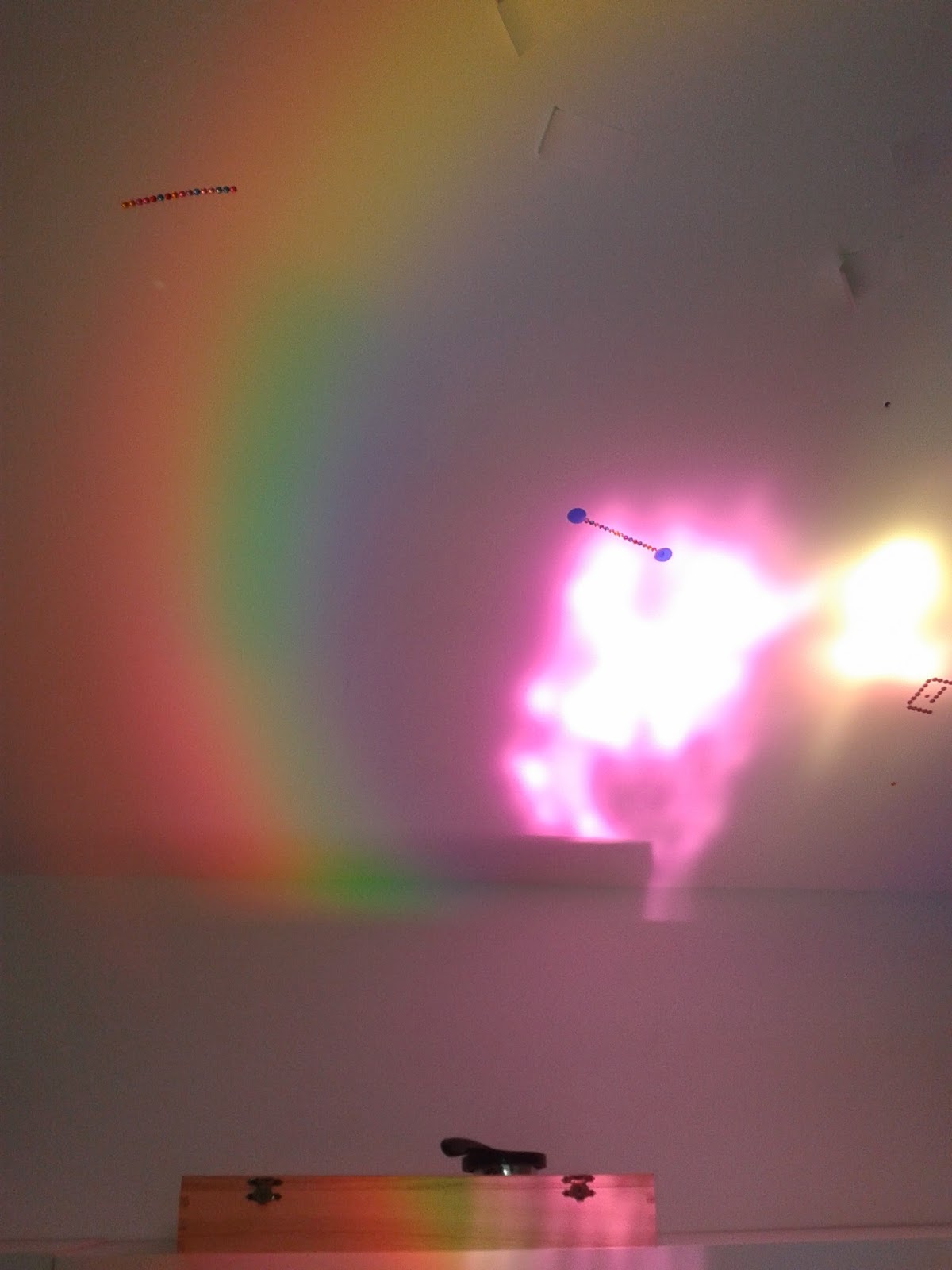
Last week, I was lucky enough to have my camera with me and capture this moment.
La setmana passada vaig tindre sort de capturar aquest moment amb la meua càmera.
Light coming through the window
Llum entrant per la finestra

Holographic paper at hand.
Paper hologràfic a mà
Let's see what happens if we place it under the light.
A vore què passa si el posem a la llum.

A RAINBOW!
L'ARC DE SANT MARTÍ!

Daddy! You must come and see this!
Pare! Vine a veure açò!


What a discovery!
Quin descobriment!


Thanks for your comments
Gràcies pels vostres comentaris

Apr 18, 2013

Coping with a brother / Assimilant al germà

Soon after Christmas, and a month after Martí was born, Aitana received this present from our neighbours. They're a very kind family and I knew they had put much tought in this present.
Poc després de Nadal, i un mes després que Martí va nàixer, Aitana va rebre aquest regal dels nostres veïns. Són una família molt amable i sabia que aquest regal no era casual.

We started playing with it immediately and, immediately as well, Aitana asked me to give the baby to the father (it was attached with a rubber band).
Començàrem a jugar amb ell immediatament i, immediatament també, Aitana em va demanar que donara el bebè al pare (anava lligat amb una goma).
Some weeks later, Aitana asked for the baby to go back to his mum's arms. And last week, she asked me to give the baby to his sister.
Algunes setmanes més tard, Aitana va demanar que el bebè tornara als braços de la seua mare. I la setmana passada, em va demanar que li'l donara a la seva germana.
She has been having a tough time coping with her brother's new arrival. She was sad because she missed me and she was also angry at him. We have tried our best to manage it, always acknowledging her feelings, helping her to find the words to express how she feels and trying to find "only mummy and Aitana moments" every day.
Aitana ha estat passant per un moment difícil amb la nova arribada del seu germà. Estava trista perquè em trobava a faltar i també estava enfadat amb Martí. Ho hem gestionat el millor que hem sabut, sempre reconeixent els seus sentiments, ajudant-li a trobar les paraules per expressar el que sent i tractant de trobar "moments exclussivament d'Aitana i mamà" cada dia. 

I've been reading this book Siblings without Rivalry: How to Help Your Children Live Together So You Can Live Too, by Adele Faber and Elaine Mazlish. Another one of their books, How to Talk So Kids Will Listen and Listen So Kids Will Talk, is one of our bibles on child rearing at home and the one on siblings is a very interesting one too. I hope to write some of the things I've learnt soon, but, meanwhile, you can have a look at this summary. 
He estat llegint aquest llibre: Siblings without Rivalry: How to Help Your Children Live Together So You Can Live Too, de Adele Faber and Elaine Mazlish. Un altre llibre seu, Cómo hablar para que sus hijos le escuchen y cómo escuchar para que sus hijos le hablen és una de les bíblies sobre criança que tenim a casa i el dels germans pareix molt interessant també. Espere poder escriure prompte algunes de les coses que he aprés, però, mentrestantpodeu fer una ullada a aquest resum.


Thanks for your comments
Gràcies pels vostres comentaris